If you started web development in the last few years, it’s easy to assume JavaScript was always the center of the universe. React, Node.js, TypeScript, Next.js, Vite… everything seems to orbit around JS.
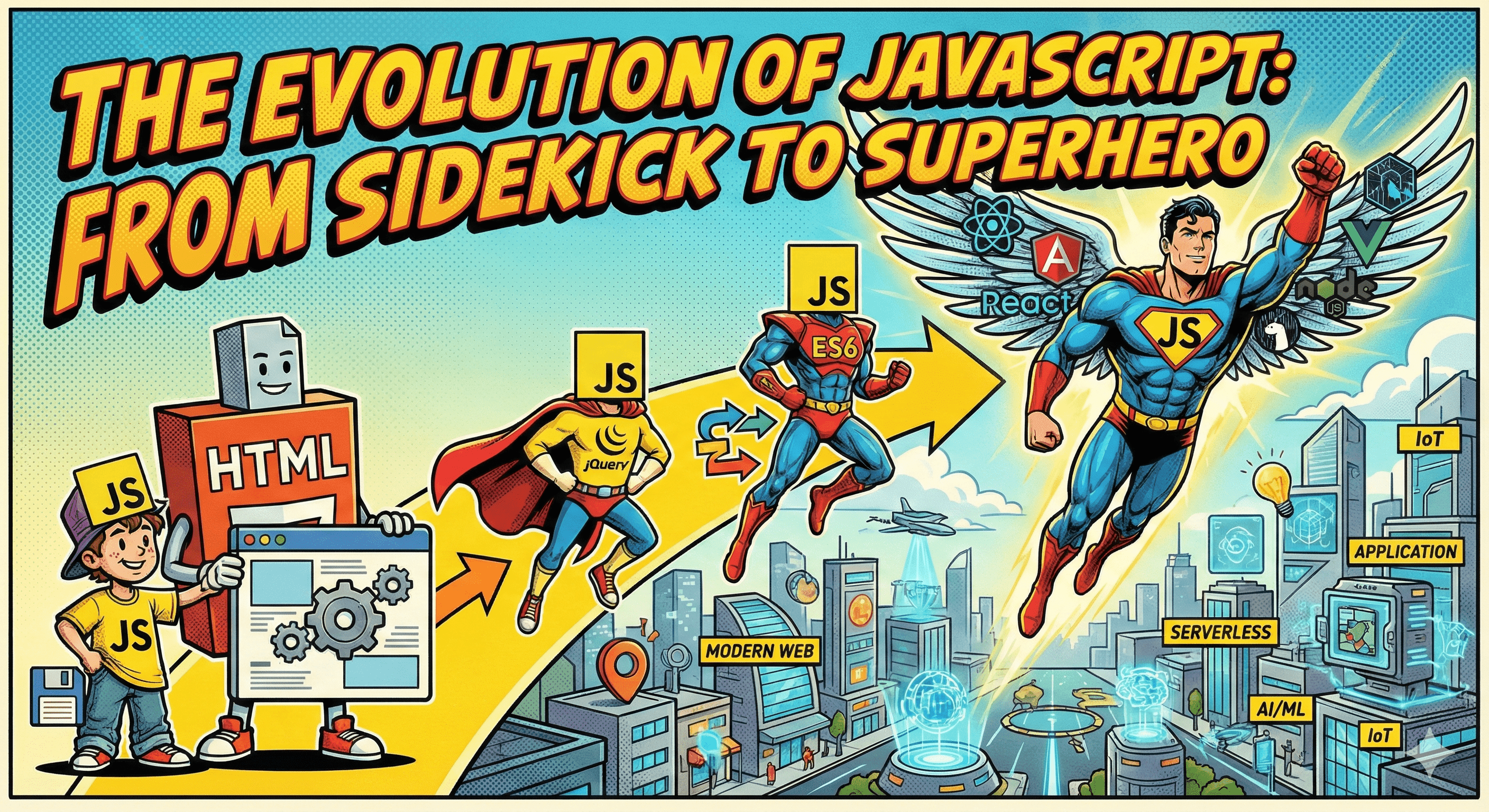
But JavaScript didn’t begin as the hero of the story. It started as a rushed scripting language, lived a long “quiet” period where it was mostly used for form validation and annoying pop-ups, and then rose like a phoenix to power apps, servers, games, and even desktop tools.
This post walks through that journey:
- How JavaScript started at Netscape
- The “silent” years where it was underestimated
- The turning point: AJAX, better engines, and Node.js
- How the decline of Flash and rise of HTML5 supercharged JS
- Where JavaScript is heading next
1. The Birth of JavaScript (1995)
The web in the mid-90s was static. HTML could structure content, CSS barely existed, and any kind of interaction was done on the server. Netscape wanted something different: a way to make pages react to users without round-trips.
Brendan Eich was hired by Netscape in 1995 and famously created the first version of JavaScript in about 10 days. It went through a small identity crisis:
- Mocha → early internal name
- LiveScript → pre-release name
- JavaScript → final brand, partly to ride on the popularity of Java
Despite the name, JavaScript was never a cut-down version of Java. It was a dynamic language with:
- First-class functions
- Prototype-based objects
- Loose typing
- A design heavily influenced by Scheme and Self
Netscape shipped it in Navigator. Microsoft quickly responded with its own implementation, JScript, in Internet Explorer. The browser wars had begun.
To avoid total chaos, the language was standardized as ECMAScript. The first specs (ES1 in 1997, ES2 in 1998, ES3 in 1999) gave us a common baseline.
2. The Quiet Years: DHTML, Pop-ups, and Pain
From around 1999 to the late 2000s, JavaScript lived in a strange limbo.
2.1 A Toy in Many Eyes
For many developers, “real work” happened on the backend (PHP, Java, .NET). JavaScript was:
- Used to validate forms before submitting
- Trigger simple image rollovers
- Show alerts and confirm dialogs
- Sadly, spawn pop-up windows and other UX crimes
It also had a terrible reputation for being:
- Inconsistent across browsers (Netscape vs IE quirks)
- Hard to debug (no good devtools yet)
- Messy, because scripts were sprinkled inline across HTML
The language itself barely evolved. ES3 (1999) was the last major update for roughly a decade. The community nicknamed this era the “JavaScript winter”.
2.2 The DHTML Era
You might see the term DHTML (Dynamic HTML) in old articles. It meant using JavaScript + HTML + CSS together to:
- Hide/show elements dynamically
- Animate menus
- Manipulate the DOM by hand
There were no frameworks, no modules, no bundlers—just inline <script> tags and lots of copy-pasted snippets from tutorial sites.
It wasn’t pretty, but it planted the seed: web pages didn’t have to be static.
3. Rising from the Ashes: AJAX, Engines, and Node
JavaScript’s “phoenix moment” began in the mid-2000s when people realized you could build full applications in the browser.
3.1 AJAX and the Web App Revolution
The quiet hero here was XMLHttpRequest—a browser API that allowed JavaScript to make HTTP requests in the background.
With it, you could:
- Load data without reloading the page
- Build email clients, maps, dashboards, and chat apps purely in the browser
In 2004–2005, apps like Gmail and Google Maps popularized this style. The term AJAX (Asynchronous JavaScript and XML) was coined, and suddenly JavaScript was not just for form validation—it was the glue of serious web apps.
3.2 jQuery and the First Wave of Libraries
The DOM APIs were low-level and inconsistent; writing cross-browser code was painful. Libraries like:
- Prototype
- MooTools
- jQuery
stepped in to smooth things over. jQuery’s $(selector) API became the way to interact with the DOM and handle events.
For many developers, jQuery was the gateway drug to “proper” JavaScript.
3.3 JavaScript Engines Go to War
As web apps grew, browsers started competing on JavaScript performance. This led to a “JS engine arms race”:
- Mozilla improved SpiderMonkey
- Apple built JavaScriptCore (Nitro)
- Google introduced V8 with Chrome in 2008
V8, in particular, changed the game with Just-In-Time (JIT) compilation and aggressive optimization. JavaScript was suddenly fast enough for serious applications.
3.4 Node.js Brings JavaScript to the Server
In 2009, Ryan Dahl released Node.js, which used Chrome’s V8 engine on the server, plus an event-driven, non-blocking I/O model.
For the first time, you could:
- Use one language (JavaScript) on both frontend and backend
- Share code between browser and server
- Build real-time systems (chat, games, live dashboards) naturally
This era also gave us npm, which grew into the largest package registry in software history. JavaScript’s ecosystem exploded.
4. ES5, ES6, and the Rapid Feature Era
JavaScript itself had to catch up with how people were using it.
4.1 ES5: The Warm-Up
In 2009, ES5 finally shipped, bringing:
Array.prototype.forEach,map,filter,reduceObject.defineProperty,Object.create- Strict mode (
"use strict";)
It was a cleanup and modernization pass that made large-scale programming less painful.
4.2 ES6 / ES2015: The Big Bang
Then came ES6 (ES2015), the true rebirth of the language. It introduced many features you probably use daily:
letandconstfor block-scoped variables- Arrow functions:
() => {} - Classes:
class User {}(syntactic sugar over prototypes) - Template literals:
`Hello, ${name}` - Destructuring and default parameters
- Modules:
import/export - Promises for better async flow
Map,Set, and other built-ins
Suddenly, JavaScript felt like a modern language. The language committee (TC39) also switched to yearly releases (ES2016, ES2017, …), so features now arrive incrementally instead of in giant, once-in-a-decade drops.
4.3 Transpilers and Supersets
Because not all browsers supported ES6 out of the box, tools appeared:
- Babel transpiled modern JS to older versions
- TypeScript added static typing on top of JavaScript
- Bundlers like Webpack, Rollup, and later Vite packaged modules efficiently
Developers started writing code in “future JavaScript” (or TypeScript) and shipping safe, compatible bundles for users.
5. The Fall of Flash and Rise of HTML5 + JS
In the early 2000s, if you wanted rich experiences—video players, games, interactive banners—you reached for Flash.
- YouTube launched with a Flash-based video player
- Many browser games were built in Flash
- Websites used
.swffiles for animations and navigation
JavaScript, HTML, and CSS were often just the frame around a Flash app.
5.1 Cracks in the Flash Empire
Flash had serious problems:
- Security vulnerabilities and frequent updates
- High CPU usage and battery drain
- Poor accessibility and SEO
- No support on many mobile devices (most famously, iOS)
At the same time, browsers were quickly advancing:
- HTML5 introduced the
<video>,<audio>, and<canvas>elements - CSS gained animations and transforms
- JavaScript engines became much faster
This meant the web platform could now handle things that previously required Flash.
5.2 YouTube’s Transition
YouTube played a symbolic role. For years, it relied on Flash for video playback. Gradually, it:
- Introduced an HTML5 player as an experimental option
- Made HTML5 the default for many browsers
- Eventually moved away from Flash entirely
Once the biggest video site on the planet switched to HTML5 + JS, it sent a clear message: the future of rich web experiences belonged to native web technologies, not plugins.
5.3 Adobe Ends Flash
In 2017, Adobe announced the end of life for Flash, and support officially stopped at the end of 2020. Major browsers now block Flash content.
The gap Flash left was filled by:
- JavaScript frameworks and libraries
- HTML5 APIs (video, audio, canvas, WebGL)
- WebAssembly for near-native performance
The death of Flash was painful for some legacy content, but it massively accelerated investment in JavaScript and the web platform.
6. The Modern JavaScript Era
Today’s JavaScript ecosystem is almost unrecognizable compared to the DHTML days.
6.1 Frameworks and Meta-Frameworks
- React, Vue, and Angular made component-based UIs the norm
- Meta-frameworks like Next.js, Nuxt, and SvelteKit handle routing, data fetching, and rendering on both client and server
- The line between “frontend” and “backend” has blurred: server components, edge functions, hybrid rendering
6.2 TypeScript Everywhere
TypeScript has gone from “nice extra” to default choice in many teams:
- Better tooling (autocomplete, refactorings, error checking)
- Safer refactors in large codebases
- Still compiles down to plain JavaScript
Most modern frameworks ship first-class TypeScript support.
6.3 JavaScript Beyond the Browser
Thanks to V8 and similar engines, JavaScript runs:
- On servers (Node.js, Deno, Bun)
- In desktop apps (Electron, Tauri)
- In mobile apps (React Native, NativeScript)
- On edge networks (Cloudflare Workers, Vercel Edge Functions)
JavaScript is no longer “the thing that runs in the browser.” It’s a general-purpose runtime with a massive ecosystem.
7. The Future of JavaScript
So where does JavaScript go from here?
A few trends already visible:
- Smaller, faster tooling
- ESBuild, Vite, Bun, and others focus on speed and simplicity
- Better DX (developer experience)
- Frameworks hiding config, smart defaults, and integrated data-fetching
- Interplay with WebAssembly
- Heavy-compute parts in Rust/C++ compiled to WASM
- JavaScript orchestrating UI and glue logic
- Gradual typing and safer code
- TypeScript and type checkers like Flow or static analysis tools baked into editors and CI
- Standardized web platform APIs
- New APIs (WebGPU, WebRTC, Web Animations, etc.) that JavaScript can talk to directly
One thing seems clear: JavaScript is not going away. It may evolve, share space with other technologies, and change syntax and patterns—but as long as the browser is the primary application platform, JavaScript (and its typed cousin TypeScript) will sit right at the center.
Closing Thoughts
If you are learning JavaScript today, you’re standing on top of 30 years of evolution. Understanding that history not only makes you appreciate the language more—it also helps you see where it’s heading next.
The web keeps reinventing itself, and JavaScript keeps reinventing with it.
Vikram Dokkupalle
Frontend Engineer & UI/UX Enthusiast. Passionate about React, performance, and clean design.